

With a required 15% increase in seasonal efficiency looming in 2023, original equipment manufacturers (OEMs) are being challenged to design HVAC rooftop units (RTUs) that both meet the immediate efficiency requirements and also set the stage for a refrigerant transition in 2025 and beyond. Meeting the challenges requires that new hardware designs be more than ‘a little bit better’; rather, complete shifts in technology are called for. Insights on the changing technologies and regulatory climate were provided at EnVisioneering Connect!, Danfoss' first-ever virtual conference for the North American HVACR industry.
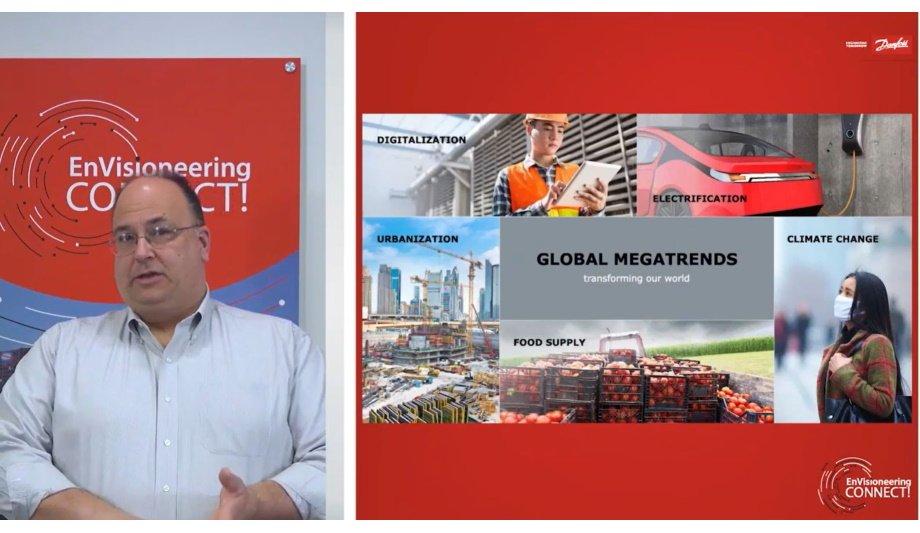
EnVisioneering Connect! virtual conference
Compressors are becoming more efficient and there is a shift from fixed air volume flow to variable air volume and speed. More electronic devices will provide better metering of refrigerant into the units for optimized heat exchange.
Manufacturers are seeking to do more with less and to squeeze more into a smaller package
There is a move to micro-channel heat exchanges that permit a smaller footprint versus copper fin designs. Manufacturers are seeking to do more with less and to squeeze more into a smaller package.
“The OEMs are doing the best they can to minimize the size, while keeping the same ‘curb size’ to simplify installation in the same space,” said Victor Marinich, Global Marketing Director, A/C, Danfoss, adding “As the technology evolves, installations will become more complicated given the variable speed fans, variable air volumes and so forth. There will be more electronics, when it comes to trouble-shooting and it will take more work commissioning and getting the electronics right.”
Achieving new functionality in an efficient, effective way
New designs must use 15% less energy without using more raw materials in manufacture. New functionality must be achieved in an efficient, effective, and cost-efficient way.
Given the upcoming refrigerant transition in 2025, there are a ‘lot of moving parts’ that OEMs must think about. In effect, OEMs must accommodate energy efficiency requirements of 2023 and refrigeration transition of 2025 at the same time – there is no time for an additional redesign in the short time window.
Major trends include digitalization, urbanization
Several megatrends are guiding the path towards more efficient dedicated outdoor air systems (DOAS) and rooftop units (RTUs). The trends are digitalization, urbanization, electrification, climate change and food supply.
With regards to climate change, Victor Marinich said “The greenest energy is energy we don’t use,” a principle that undermines the transition to more efficient units. As millions of people move into cities (urbanization), there are more housing needs and more air conditioning. Electrification will decrease our use of fossil fuels.
 |
| The industry will need to use 40% less R410A or use new refrigerants with a lower GWP |
The refrigerant transition
The refrigerant transition, specified by the American Innovation and Manufacturing (AIM) Act of 2019, requires a 40% reduction in carbon dioxide equivalent emissions by 2024.
The industry will need to use 40% less R410A (today’s most popular refrigerant with a globing warming potential (GWP) of 2088) or use new refrigerants with a lower GWP. New refrigerants will need to have a GWP limit of 750 or less.
Rooftops and DOAS will transition by 2025
Another choice is R454B refrigerant, which mimics performance of R410A refrigerant
Rooftops and DOAS will transition by 2025. Of the alternative refrigerants, R32 refrigerant is higher pressure and denser, which allows for a smaller unit (and lower cost), but all components must be rated for higher pressure.
Another choice is R454B refrigerant, which mimics performance of R410A refrigerant. Current components could be used in a newer system with similar capacity and performance. However, there are no comparable advantages of smaller hardware size.
Balancing the advantages of both new refrigerants
The industry will seek to balance the advantages of both new refrigerants when going to market. Redesign considerations include compatibility, performance, price, pressure, and temperature. Because the newer refrigerants are mildly flammable, additional safety precautions are needed.
A challenge is that among U.S. Commercial Building stock, there are about 47% (of 6 million buildings) that are using a unitary product. Thus, there is a lot of refrigerants to consider.
Greater emphasis on indoor air quality (IAQ) and comfort
Additional trends impacting RTU and DOAS units include an increasing emphasis on indoor air quality (IAQ) and comfort. There is a transition to more Internet of Things (IoT) connectivity enabling more efficiency, diagnostics and preventative maintenance.
There are also resource pressures, including manpower requirements and raw materials availability
There are also resource pressures, including manpower requirements and raw materials availability, and pricing (including copper, steel, and aluminum).
As the move toward renewable energy and electric heating continues, only 10% of rooftop systems are currently reversible heat pump units, although the technology has progressed and offers better performance since the 1970s.
Rooftop units (RTUs) and DOAS units
DOAS units supply 100% outdoor air and bring it into the building, while a traditional RTU mostly recirculates indoor air. DOAS units work in conjunction with a rooftop unit or other types of air conditioners.
The DOAS pulls the moisture out of the outdoor air (latent load) and brings dry air in the building, thereby enabling the RTU to focus on the temperature of the air (sensible load). DOAS advantages include the use of a smaller primary AC system, and more ventilation and filtration to improve IAQ. In effect, DOAS equipment complements RTUs.

- Government Regulations
- Commercial HVAC
- Refrigerants
- R-410a
- R-22
- R-32
- EPA
- DOE
- Energy Star
- Energy Efficiency
- Capacity
- Residential HVAC
- 2LA Flammable Refrigerants
- International Standards
- Safety Standards
- Flammability
- HVAC Plumbing
- HVAC Software
- HVAC Maintenance
- Automation & Controls
- Remote Monitoring
- Smart Home
- Building Management
- HVAC IoT
- Mergers & Acquisitions