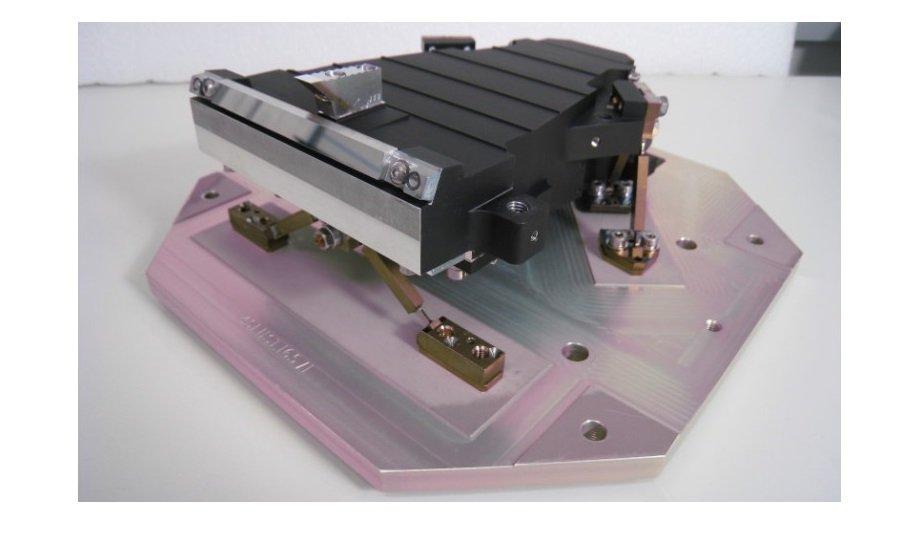

The successful launch of the James Webb Space Telescope (JWST) was a long-awaited event for the Optics team here at SSTL because way back in 2006, they started work on the Integral Field Unit (IFU) for an instrument called NIRSpec (Near InfraRed Spectrograph), one of four science instruments on board the mission and SSTL have been waiting patiently since then for launch.
Optics module
The optics module SSTL supplied for JWST is highly complex with over 90 mirrors precisely aligned into a module
The optics module SSTL supplied for JWST is highly complex with over 90 mirrors precisely aligned into a module approximately the size of a small shoebox, and it's a key part of NIRSpec.
The IFU takes a 1mm2 sample of the scene image and slices the square image into strips which are reassembled into a long linear virtual slit image as input to the spectrometer for projection onto a matrix detector array to be read.
Infrared light detection
JWST can detect infrared light generated by galaxies as they formed more than 13.5 billion years ago, in the aftermath of the Big Bang. Ultraviolet and visible light emitted by those very first luminous objects has been stretched by the universe’s continual expansion into “redshift” infrared light.
JWST is designed to detect this infrared light and scientists will use the data to study the origin and evolution of planets and other bodies in the solar system which is too old and too distant for Hubble to observe.
Follow-on mission
The $10bn James Webb Space Telescope is the follow-on mission to the Hubble Space Telescope and will be positioned 1.5 million kilometers away between the Earth and Sun where the gravitational forces are canceled.
Approximately 2 weeks after launch, JWST will unfold from its launch configuration into its operational configuration with a heat shield that is nearly the size of a tennis court shielding a 6.5m telescope, the biggest telescope ever launched into Space. The telescope is formed after unfurling a set of “petal” mirrors.
State-of-the-art monolithic metal mirrors
The IFU project provided the opportunity for SSTL to utilize state-of-the-art monolithic metal mirrors with complex forms made by single point diamond machining, the whole instrument except for the legs being made from a single billet of aluminum alloy.
The design required mastering the problems arising from working at cryogenic temperatures (32Kelvin). The project was initially managed by acclaimed space scientist and TV presenter Dr. Maggie Aderin Pocock. SSTL supplied the IFU to NIRSPEC prime, Airbus. JWST is an international collaboration between NASA and its partners, ESA (European Space Agency) and the Canadian Space Agency.

- Government Regulations
- Commercial HVAC
- Refrigerants
- EPA
- DOE
- Energy Star
- Energy Efficiency
- Capacity
- Residential HVAC
- International Standards
- Safety Standards
- Flammability
- HVAC Plumbing
- HVAC Software
- HVAC Maintenance
- Automation & Controls
- Remote Monitoring
- Smart Home
- Building Management
- HVAC IoT
- Mergers & Acquisitions