Meeting a project’s overarching design goals is vital in the building and construction sector. Creating a sustainable building could be one of these goals — driven by company commitments, federal policies, and state-based initiatives. However, the priorities of minimizing capital and long-term operating costs and maintaining project timelines often prevail.
Frequently, the perception in the industry is that these priorities — especially cost — are incompatible with designs and technologies that help decarbonize buildings.
Cutting emissions and optimizing costs
Organizations can take an incremental approach without compromising on cost
However, our experience with heating, ventilation and air-conditioning (HVAC) systems has shown that cutting emissions and optimizing costs are not mutually exclusive when we leverage the right technologies and design strategies.
Decarbonization isn't a one-time event. Reducing emissions is a continuous process with many paths. Organizations can take an incremental approach without compromising on cost.
Finding the right balance requires weighing project priorities, the building’s environment, short- and long-range facility plans and available technology solutions. To achieve this balance, energy modeling is an essential tool.
Weighing up design goals
When it comes to sustainability and decarbonization in HVAC systems, there are three primary levers: electrification of heating using heat pumps, improving energy efficiency and using lower global warming potential (GWP) refrigerants.
Cost priorities can often be aligned more easily with sustainability goals than expected
Each project's physical environment and framework conditions will influence the mix of these three levers. Cost priorities can often be aligned more easily with sustainability goals than expected. For example, the local climate substantially impacts electrification.
In hotter climates, electrification is far easier than in cold ones, where heat pumps require much more electricity when heating. In extreme cold temperatures, heat pumps will eventually require a back-up like natural gas (NG) to provide supplemental heat. A hybrid system using NG as a back-up to the heat pump also avoids oversizing the heat pump to cope with the most extreme conditions – which only occur infrequently.
Hybrid heating systems come into their own
Hybrid systems can significantly reduce emissions compared to traditional fossil-fuel-only heating systems and save costs, especially in areas with access to cheap renewable electricity from solar PV plants, wind farms and hydro or geothermal sources. By switching over to NG when temperatures get too low or when insufficient renewable electricity is available, building owners can not only save costs but also hedge against grid outages in the coldest months of the year.
It’s critical to pick the right point for your hybrid system to switch from one fuel source to another. By changing to the lowest rate — electricity or gas prices — at any particular time, you can save money while making significant CO2 savings. Alternatively, the time to switch could be based not only on energy costs but also on emissions reductions, allowing the designer to optimize around different design goals.
Sustainability doesn’t necessarily command a premium
A study from the National Renewable Energy Laboratory demonstrates that decarbonization and broader sustainability goals can be achieved alongside other design goals. When comparing conventional school buildings with zero-energy schools — buildings that produce as much renewable energy as they need to operate — the NREL found that the latter offers several benefits. Zero-energy schools require less energy and offset demand using on-site renewable energy.
Zero-energy schools require less energy and offset demand using on-site renewable energy
The study indicates that zero-energy school buildings can be designed and built within conventional budgets — and they can cost less. By applying an integrated approach to design and construction, the extra cost of the zero-energy systems can be offset by the greater efficiencies they facilitate.
The study lists downsizing heating, ventilation and air conditioning among the benefits that help reduce capital and operational expenditures. However, as we have seen, balancing each building's inherent complexities is the key to achieving these benefits. This is where energy modeling comes into play.
Balancing sustainability and design goals
Energy models tie together all factors affecting HVAC design and installation. They are a tool for comparing many design alternatives quickly and cost-effectively to find the most appropriate solution to the project’s design goals.
Energy modeling can simulate various system configurations to show the effect of using different types of equipment, such as an electric heat pump compared to a conventional HVAC system. Modeling can also factor in decarbonization policy incentives that may affect the economics and viability of a proposed system.
Various system-design options
In addition, life-cycle analyses of different keys can provide a clearer long-term financial picture
In addition, life-cycle analyses of different solutions can provide a clearer long-term financial picture. Models can forecast long-term costs, performance and return on investment of various system-design options, which can make it easier to get sign-off projects from investors.
With its data-driven approach, energy modeling can also prevent overengineering that could lead to unnecessary expenses. A US Department of Energy study has shown that projects using energy modeling perform better and can have shorter returns on investment than those that don’t.
The future of HVAC: A harmonized approach
As sustainability codes, standards and regulations evolve throughout the US, energy modeling becomes increasingly vital for harmonizing environmental priorities with core design objectives — enabling balanced, effective solutions that drive greener, more resilient outcomes for buildings, businesses and the planet.
By integrated advanced modeling practices into the design process, the HVAC industry can support the transition to a low-carbon future without sacrificing economic feasibility or operational efficiency.
 |
| HVAC industry can support the transition to a low-carbon future without sacrificing economic feasibility. |
Example analysis
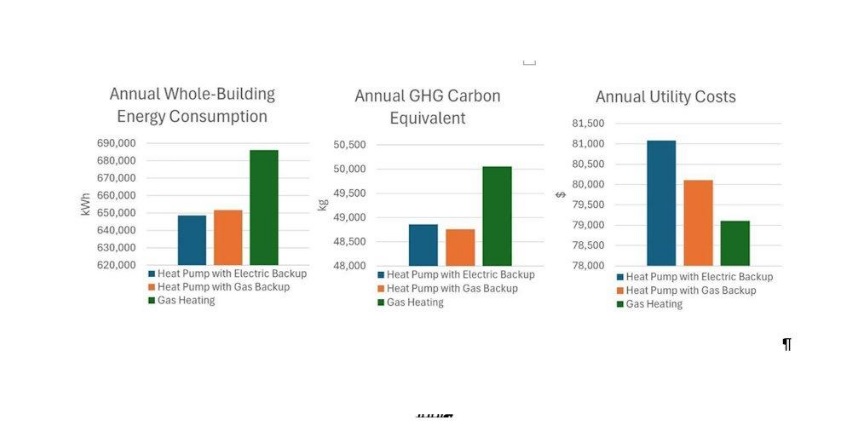
A 54,000 ft² office building prototype, compliant with ASHRAE 90.1 standards, was modeled in Denver, Colorado, using Daikin Applied EA Pro software, powered by the US DOE’s EnergyPlus simulation engine.
Rebel® heat pump rooftop units were assigned to serve the building. Two HVAC alternatives were analyzed for the heat pumps: (1) electric back-up and (2) gas back-up. The Environmental Protection Agency’s eGRID emission factors, representing the greater Denver regional grid, were used to calculate emissions, along with average electricity and gas utility rates for the region.
Electric back-up scenario
The results indicate that while total energy usage is lower with the electric back-up scenario—due to the higher efficiency of electric resistance heating compared to gas combustion—the annual utility costs and equivalent carbon emissions are lower with the gas back-up scenario. This is primarily because of higher electric utility rates and the electric emissions profile of the regional electric grid.
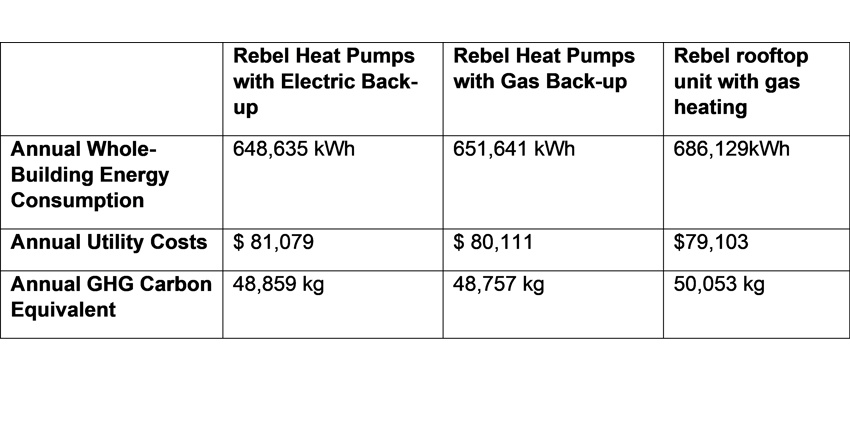 |
| The annual utility costs and equivalent carbon emissions. |
This example represents a specific scenario for demonstration purposes but highlights the importance of holistic, project-specific considerations when evaluating design alternatives to meet customer goals.