As demand continues to grow for sustainable, energy-efficient solutions in refrigeration and heating, both Europe and North America are navigating a rapid transition toward natural refrigerants.
There is a strong demand for new CO2 systems, including heat pumps and various other applications. Higher capacity compressors with larger operating envelope, such as Danfoss’ Bock HGX56 CO2 T series, will play a critical role in supporting this growing need.
Air to water heat pumps
As shown in Figure 1 and Figure 2 below, the larger operating envelope of up to 77°F and 65 bar on the suction side can improve the COP by approximately 15% for applications with higher heat source temperatures – for example, air to water heat pumps in summer conditions.
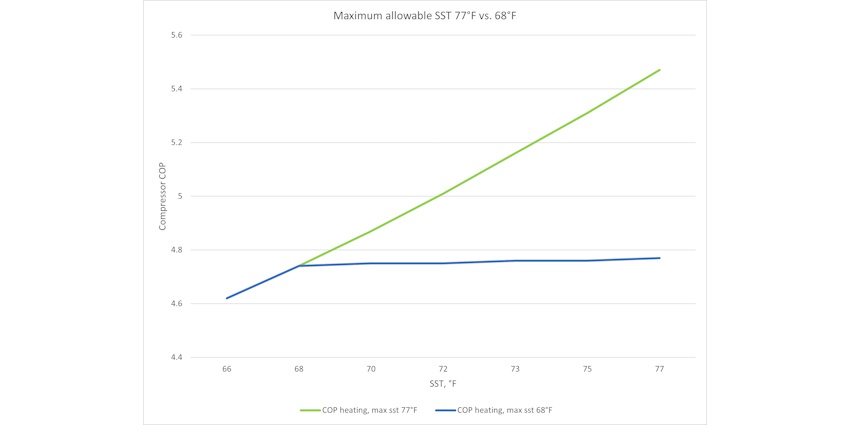 |
| Transcritical CO2 figure. |
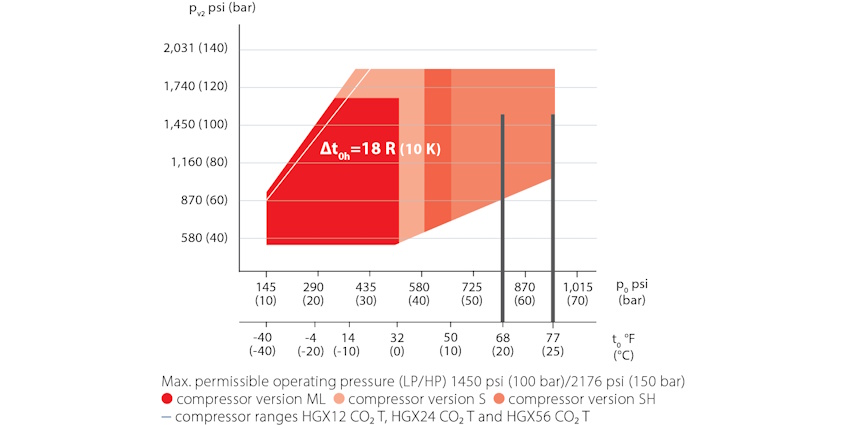 |
| Larger operating envelope of up to 77°F and 65 bar on the suction side. |
Figure 3 below shows a typical layout of a CO2 transcritical air-to-water heat pump for large systems, designed with features to boost efficiency. Such systems are already being built in Europe, with the largest compressor options, and used in heating capacities of up to 2.5 MW per rack.
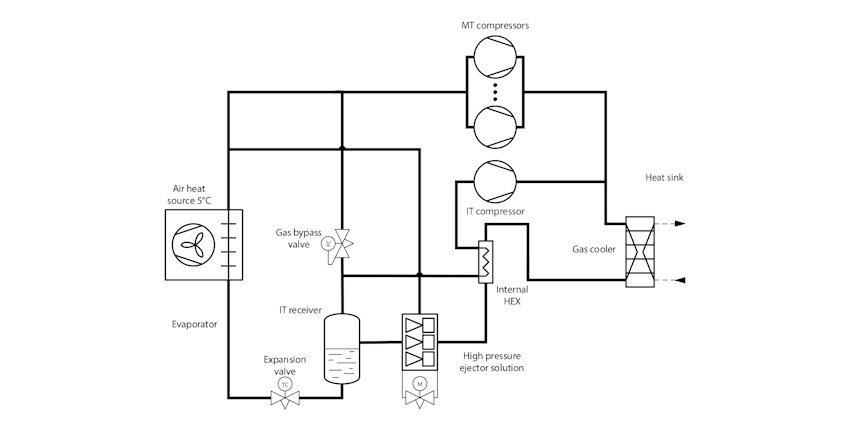 |
| Layout of a CO2 transcritical air-to-water heat pump for large systems. |
Cooling and Heating Working Together
Transcritical supermarket applications with heat reclaim are very suitable for improving the version
Transcritical supermarket applications with heat reclaim are very suitable for improving the overall refrigeration system performance. It is a highly efficient and resilient solution that provides simultaneous heating and cooling by recycling waste heat energy within the store.
More than 2,000 installations across Europe and in other parts of the world have shown that the traditional CO2 weaknesses in refrigeration applications, such as high temperatures and pressures, can be turned into profitable advantages when adding heat reclaim to the system.
In fact, the operational costs can be reduced by more than 20% by replacing conventional heating sources with heat reclaim, and the pay-back time of the heat reclaim installation is typically short, less than 2.5 years. At the same time, huge carbon savings can be made when the system is installed and maintained correctly.
Additional Applications Transitioning to CO2
CO2 is increasing in popularity for cold storage and food processing, due to some challenges of using ammonia in states with a large number of regulations, as well as the desire for distributed systems when expanding plants and the advent of larger CO2 compressors.
Some estimates show a 10% market transition to CO2 from ammonia and HFCs for systems up to 250 tons (880 kW). An example would be a cold storage facility requiring variable temperatures with stability/efficiency at partial load for garlic processing, storage and pre-cooling. The requirements for pre-cooling are 40°C/39.20°F, but for processing and final storage, −100°C/140°F is required.
CO2 System Examples
Single-stage transcritical CO2 applications are used in the field of medium temperature refrigeration
Single-stage transcritical CO2 applications are used in the field of medium temperature refrigeration. They can be operated very efficiently, if the high pressure is operated in the subcritical range over a long period. Using the high-pressure side, it is appropriate to use the application in the transcritical range in combination with refrigeration, due to a large temperature glide and a relatively high discharge end temperature for specific heat pumps and the heat recovery.
In CO2 applications in low and medium temperature refrigeration, so-called booster systems are used. High-pressure CO2 gas from the low-temperature compressor is discharged directly to the suction side of the second compressor stage. Different plant constructions of these Booster applications are used, for example, in supermarket applications.
In a cascade system, different refrigerants are used in an application. They are combined in two refrigerating circuits that are separated from each other. The high temperature stage is used as a condenser in the CO2 application. It is possible to use different refrigerants like hydrocarbons, ammonia, and HFCs like R-134A.
Keys to a Successful Installation
- Proper oil levels, adequate space for maintenance and ventilation, environmental conditions and surface setup with sufficient load-bearing capacity are all critical initial items to consider.
- Once these items have been considered and addressed properly, then you need to take extreme care during the soldering - cooling the valve body during and after and only using inert gas to inhibit oxidation products.
- The actual required pipe cross-section must be matched to the output. The tube must be sawed at a right angle with the angular tolerance being ±10.
- Pipes and system components must be clean and dry inside and free of scale, swarf and layers of rust and phosphate. Only use hermetically sealed parts.
- Lay pipes correctly. Suitable vibration compensators must be provided to prevent pipes being cracked and broken by severe vibrations.
- Ensure a proper oil return and keep pressure loss to an absolute minimum. Suction and discharge should be depressurized prior to connecting to the refrigerant system. Proper layout of the suction and pressure lines directly after the compressor is integral to the smooth running and vibration behavior of the system.
Oil return function
To ensure the oil return function will work reliably no matter what kind of system configuration you are using, Danfoss recommends incorporating oil separators or oil level monitoring equipment. For systems with long pipes and higher degree of contamination, a filter on the suction-side is recommended.
When attaching accessories with an electrical cable, a minimum bending radius of 3x the cable diameter must be maintained for laying the cable.
Voltage and frequency values
Compare the voltage and frequency values with the data for the mains power supply
Connect the compressor motor in accordance with the circuit diagram (see inside of terminal box). Compare the voltage and frequency values with the data for the mains power supply. Only connect the motor if these values are the same compressors marked in this way are suitable for direct or part winding start.
The motor winding is divided into two parts: part winding 1 = 50 % and part winding 2 = 50 %. This winding division reduces the start-up current during a part winding start to approx. 50 % of the value for a direct start.
Reversed fields of rotation
In the factory, as shown below in Figure 4, the motor is switched for direct starting (YY). For part winding start (Y/YY), remove the bridges and connect the motor feed cable according to the circuit diagram.
-850x425.jpg) |
| The motor is switched for direct starting (YY). |
Failure to comply results in reversed fields of rotation and can cause motor damage. After the motor has started up with part winding 1, part winding 2 must be switched on after a maximum 1-second delay.
Failure to do so can be detrimental to the service life of the motor. Ensure that power is supplied via QA2 to winding 1 (50%) (1U1/1V1/1W1) and via QA3 to winding 2 (50 %) (2U1/2V1/2W1). The motor contactors (QA2/QA3) are each to be rated for approx. 50% of the maximum operating current.
Danfoss BOCK compressors
Transcritical CO2 compressors, like the Danfoss BOCK product line, offer a wide span of capacities with up to 162 kW of cooling capacity (14°F/95°F/18R/60 Hz) and 420 kW of heating capacity (41°C/77°C (100 bar)/18R/60 Hz) for many different product applications, including food retail, heat pumps, district heating, industrial refrigeration and process heating, reversible chiller/heat pumps for HVAC, cold storage, chillers, and data centers.
Low and medium temperature levels are available, with high stand still pressures. This high capacity reduces the need for multiple compressors, simplifying system design and reducing investment costs. The Danfoss BOCK compressors also feature a high-pressure rating of 130 bar in operation/150 bar at stand still on the high side and 65 bar in operation/100 bar at stand still on the low side.