
No matter what kind of building they own, it’s almost certainly going to have an HVAC system in place. The HVAC system of any building is designed to maintain the indoor air and keep it at a comfortable level.
Not only does this mean heating or cooling the air to the level set by whoever is operating the thermostat, but it also means filtering air and keeping the indoor air of the building free from outside pollutants that might contaminate it.
Effectiveness of the HVAC system
If the HVAC duct system is in perfect working order, it will achieve both of these goals with no problem
If the HVAC duct system is in perfect working order, it will achieve both of these goals with no problem. If it’s not, however, then not only could harmful pollutants enter the indoor air space of the building, but they’ll also be wasting energy and losing what could be a large sum of money each month on energy bills. This is why air duct leakage testing is so important.
The only way to truly measure the effectiveness of the HVAC system is to seal it off and use special equipment to run a pressurized test and see if any air is leaking through holes in the ductwork. This is a procedure that is done during the rough-in process, but it can be performed throughout various stages of construction.
Some percentage of duct leaks
It can also be performed long after construction has been completed if they suspect their ductwork may have been damaged or compromised in some way. This is a very common occurrence, and most buildings now suffer from some percentage of duct leaks.
In case they weren’t aware of the overall importance of having an air duct leakage test performed on the HVAC system, let’s go over a few of the details, such as how it’s done and what to do with the results when it’s completed.
Duct Leakage Test Comes in 2 Varieties
There are two main types of air duct leakage tests:
1. TDL
The combination of fan flow sizes and pressure is used to determine exactly how airtight
TDL stands for “total duct leakage.” It measures the total amount of leakage they have going into both conditioned and unconditioned spaces. TDL testing is performed with a duct leakage tester, which is a diagnostic tool that is used for measuring the airtightness of ventilating, air heating, and air conditioning ductwork.
This tester is made up of a calibrated fan that is used to measure airflow rate, as well as a pressure sensing device that will be able to measure the amount of pressure that is put out by the fan flow. The combination of fan flow measurements and pressure is used to determine exactly how airtight the ductwork is.
Return air grills or supply registers
The return air grills or supply registers will be sealed off with HVAC tape, with one register being left unsealed. This register will have a calibrated fan hooked up to it and pressure will be monitored in the ductwork while the calibrated fan delivers air into the system.
As the device blows air into the system, pressure will build up and force air out through any leaks that might be present. The tighter a system is, the less air will be needed to facilitate a change in ductwork pressure. TDL tests can be done by either pressurizing or depressurizing the ductwork system, but depressurization is risky because it can suck in contaminants from the outside.
2. LTO
LTO testing measures only the amount of leakage they have going into unconditioned spaces
LTO stands for “leakage to outside.” LTO testing measures only the amount of leakage they have going into unconditioned spaces, like uninsulated crawlspaces, unconditioned attics, and similar areas.
LTO testing can be performed in a similar way to TDL tests but with the house being pressurized at the same time as the ductwork so that technicians can measure the amount of airflow needed to equalize the pressure.
Which Duct Leakage Test Method is More Effective?
While both methods are effective at measuring leakage, LTO testing is more effective in improving energy efficiency because that air is essentially leaking directly out into nowhere, while air leaking into conditioned spaces is still technically going into the areas they want it to, just with the possibility of contaminants getting in through the leaks and compromising the air in the entire building.
Aeroseal’s Duct Leakage Test Provides Real Results
Aeroseal uses pressurization to identify every single leak in the ductwork before distributing
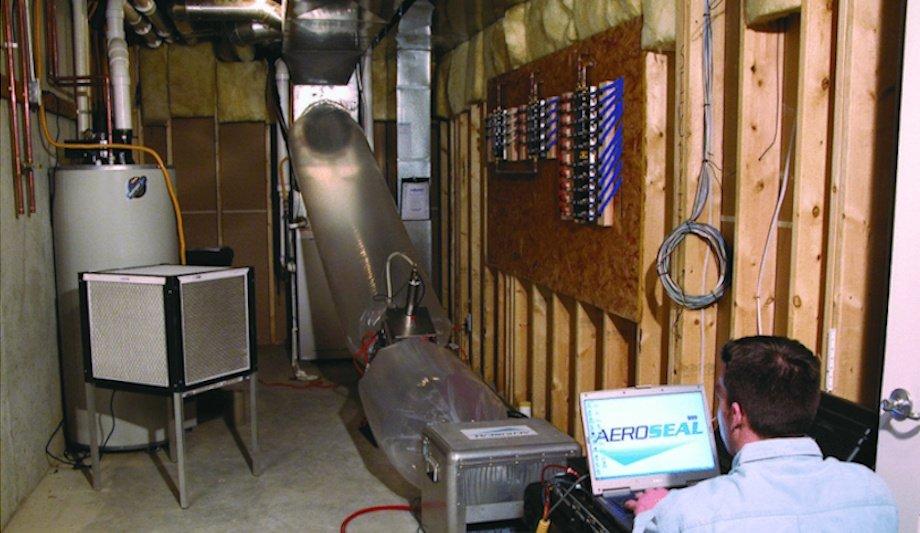
Obviously, they aren’t going to be doing this testing themselves, so it’s best to bring in a professional team of HVAC techs, like the crew at Aeroseal. Such professionals will perform the testing described above as well as seal up the leaks they find, all in the same process.
Aeroseal uses pressurization to identify every single leak in the ductwork before distributing a nontoxic, water-based sealant throughout the duct and air vent system, which plugs them up. This sealant completely seals off leaks without any mess or cleanup.
How much the ducts were leaking
They’ll be able to see the improvements as they happen in real time and then get a before-and-after assessment of how much the ducts were leaking, and how airtight the system is now that it’s been sealed up.
Air duct leakage testing is extremely important if they want to maximize the energy efficiency in any type of building, and professional HVAC techs like those at Aeroseal are some of the best around for not only finding leaks but sealing them, too.