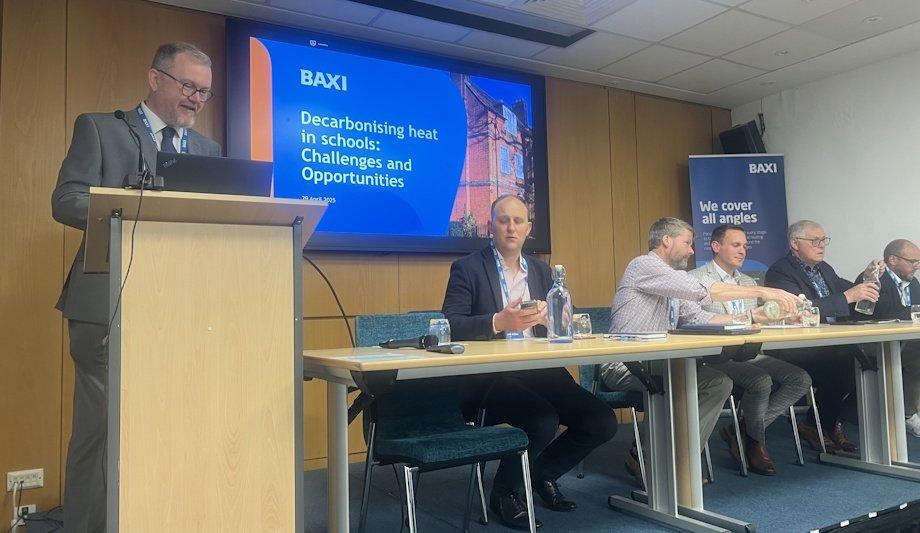

A survey conducted by Baxi of 200 state school estate managers, consultant engineers, and M&E contractors has found that while enthusiasm for net zero and support for low-carbon heating systems in schools is thriving, persistent barriers remain.
The survey found extremely strong support for net zero within schools, with 90% of estates managers who responded agreeing that net zero is a priority, a sentiment echoed by 78% of consultant engineers and contractors. 99% of the school estate managers surveyed reported having a net-zero plan in place.
Low-carbon heating and net zero
The most prominent was technical difficulty as a barrier to deployment
Experience and satisfaction with low-carbon heating systems within schools was also high, with 95% of school estate managers having replaced a fossil fuel boiler with a heat pump in their buildings previously. 97% of all school estate managers (87% of all respondents) viewed heat pump performance and operating costs favorably.
Despite the strong support for low-carbon heating and net zero in schools, the study also uncovered significant challenges faced by respondents when opting to install a low-carbon heating system. The most prominent was technical difficulty as a barrier to deployment.
Decarbonization projects
With 36% and 39% of school estate managers and consultant engineers and contractors respectively identifying the challenge, there may be a skills gap which can stall decarbonization projects.
Both groups also agreed that additional electricity capacity needed for low-carbon heating solutions was a challenge, with 36% of consultant engineers and contractors outlining this as a barrier to decarbonization.
Other core challenges
School estate managers placed core challenges, including the financial and technical feasibility
School estate managers identified other core challenges, including the financial and technical feasibility of school heating system changes, infrastructure requirements, and the length of project timelines as any major refurbishment projects are typically restricted to the fixed window of time of the summer holiday period.
Additionally, the UK’s electricity pricing is placing a persistent barrier in front of those at the forefront of decarbonizing state schools.
Hybrid heat pump systems
The study did identify potential solutions in the form of hybrid heat pump systems and prefabricated packaged solutions. Among Baxi survey respondents, hybrid heat pumps are a popular solution, with a slight preference for this technology over a standalone heat pump system.
80% of the consultant engineers and contractors surveyed would be likely to recommend a hybrid system, and support for hybrids among school estate managers increased with school size.
Hybrid heat pump solutions
The shorter structure timeframes need installing a hybrid solution vs reversing to a heat pump system
This could be attributed to several factors, including costs, integration with existing hydronic systems, and the shorter installation timeframes required to install a hybrid solution versus converting to a standalone heat pump system.
However, grant support for hybrid heat pump solutions under the Public Sector Decarbonization Scheme (PSDS) is limited, despite strong backing for the technology.
Policy recommendations
Baxi is calling for four clear steps that they believe the government must take to ramp up the decarbonization of state schools and remove barriers preventing the installation of hybrid heating systems within public buildings.
- Include heating system upgrades for schools within existing public sector support schemes, utilizing GB Energy to support
- Include hybrid heating systems within existing support schemes
- Address the imbalance in price between gas and electricity
- Address the skills gap to help deliver clean energy projects.