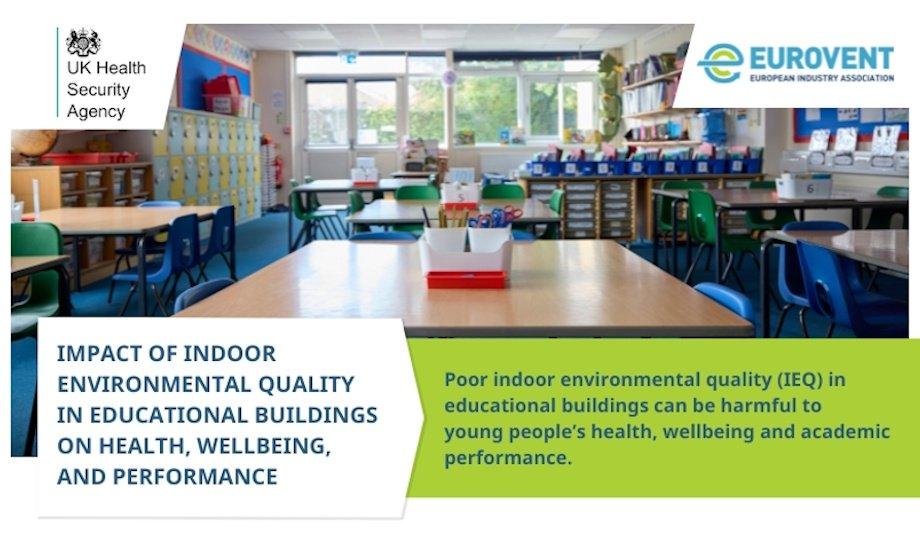

Eurovent and UKHSA jointly release a scoping review examining the impact of indoor air quality and thermal conditions in educational buildings on health, well-being, performance, and absenteeism.
Eurovent and the UK Health Security Agency (UKHSA) are pleased to announce the release of a comprehensive literature review published in Environments, an international, peer-reviewed, open-access journal on environmental sciences.
How IAQ and thermal conditions impact
The review synthesizes interdisciplinary studies to map current evidence and highlight gaps in the understanding
The literature review titled ‘Impact of Indoor Air Quality, Including Thermal Conditions, in Educational Buildings on Health, Wellbeing, and Performance: A Scoping Review’, explores the far-reaching effects of indoor environmental quality (IEQ) in schools, nurseries, and universities on occupant health, well-being, academic performance, and absenteeism.
The review synthesizes interdisciplinary research to map current evidence and highlight gaps in the understanding of how IAQ and thermal conditions impact psychological and physiological outcomes in educational settings.
environmental interventions enhance learning
Key insights include correlations between poor IEQ and increased absenteeism, diminished cognitive performance, and adverse health symptoms, particularly among children and young adults.
UK Health Security Agency (UKHSA) Principal Public Health Specialist, Sani Dimitroulopoulou, stated that: "While evidence grows on how indoor environment affects school children’s health, we must better understand how environmental interventions enhance learning."
Sani adds, "Together with Eurovent, we have mapped out how future gains in educational outcomes, driven by improved indoor environmental quality, can be quantified. This is the key to supporting every child’s academic growth and well-being."
Long-term educational and societal benefits
Eurovent Deputy Secretary General, Stijn Reneeboog, said: "In partnership with UKHSA and drawing on an extensive body of scientific literature, our project shows that poor classroom environments affect children’s health and learning. With these results now published, we hope to support investment in healthier schools that deliver long-term educational and societal benefits."
Improve indoor health standards
The review is designed to guide policymakers, school administrators, health authorities, building engineers, and educators in creating environments that support optimal learning and development.
The publication, available as open access in Environments, marks an important milestone in Eurovent and UKHSA's joint efforts to improve indoor health standards across educational institutions.