When the COVID-19 pandemic disrupted global supply chains, it highlighted the vulnerabilities in acquiring essential medical supplies like masks, gloves, gowns, and hairnets. Hospitals across the United States experienced significant challenges in procuring these critical items, emphasizing the need for reliable domestic production solutions. Addressing this demand, a coalition of investors and manufacturing experts launched a U.S.-based personal protective equipment (PPE) company in collaboration with hospital systems and government aid.
Healthcare professionals demonstrated a preference for sewn-style hairnets, which offer a secure fit, durability, and ease of use. Unlike pleated hairnets, typically dispensed from a ribbon and tough to manage, the sewn alternatives are efficiently boxed and simple to use. However, the assembly of these sewn hairnets was traditionally manual and overseas, creating a challenge in duplicating their design without reliant on stitching.
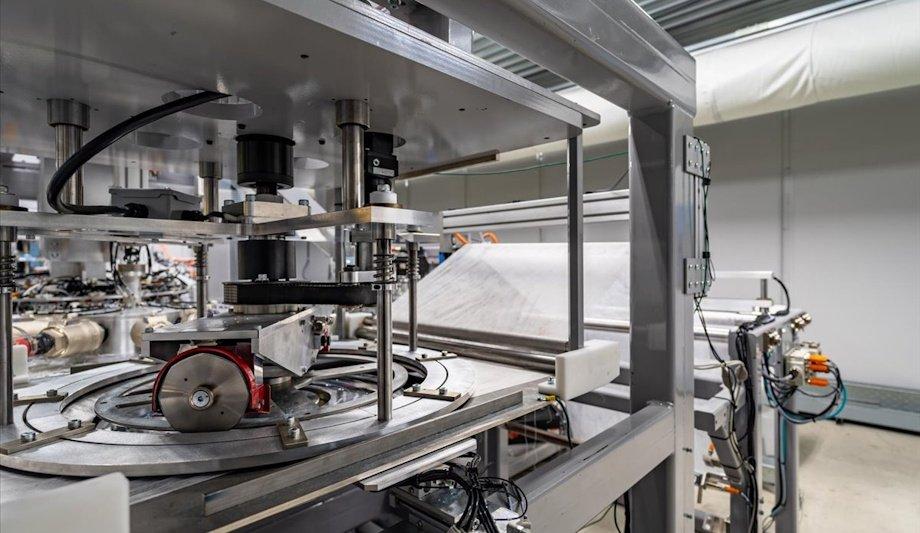
To address this, Wauseon Machine, a leader in integrated automation solutions, developed an innovative approach using thermoplastic welding. This method seamlessly integrates elastic and spunbond fibers without stitching, allowing for full automation of the hairnet production process. Despite this breakthrough, the use of spunbond material posed unique challenges due to its sensitivity to heat and moisture.
During initial testing phases, static buildup posed a problem, disrupting material handling and weld consistency. To counteract this, Wauseon constructed a specialized cleanroom facility with controlled temperature and humidity settings. This setup allowed materials to acclimate before production, thereby ensuring high-quality output.
Flexibility in the manufacturing process was also essential as it allowed for the production of varying hairnet sizes. Wauseon engineered the system to facilitate quick and precise changeovers, minimizing downtime and maintaining quality across different product sizes.
Under conventional circumstances, product design precedes equipment development. However, for Wauseon’s project, product definition and equipment creation occurred simultaneously, creating substantial risks. To navigate these risks, Wauseon applied its structured Automation Project Process (APP), which helped delineate fixed zones for stable development while allowing flexibility in evolving areas.
Wauseon faced challenges when the customer’s in-house spunbond production yielded a thinner material than expected, compromising weld integrity. The engineering team adapted by refining the heating elements and implementing sensitive RTD feedback sensors, improving temperature control and maintaining throughput despite material discrepancies.
With the production demand high, Wauseon’s dual-machine setup operated efficiently, producing one hairnet per second. Although other technologies like ultrasonic welding were considered, thermoplastic welding proved faster and more scalable. Its implementation realized the client’s budget and volume objectives without compromising quality.
Since going operational, Wauseon's system has produced millions of hairnets, supporting healthcare workers nationwide. This project reflects a significant achievement in creating resilient manufacturing solutions, even amidst uncertainty. It also highlights the potential for similar strategies in sectors like defense and aerospace, aiming to re-shore production of critical components efficiently.
When COVID-19 disrupted international shipping, it revealed just how fragile global supply chains could be, especially for essential medical equipment.
Across the U.S., hospitals and healthcare providers found themselves unable to procure basic items like masks, gloves, gowns, and even hairnets. The result was more than inconvenience; it was a systemic vulnerability that demanded urgent domestic solutions.
U.S.-based PPE business
Large hospital systems and national healthcare providers quickly realized that without access to basic items like masks, gowns, gloves, and even hairnets, their operations could grind to a halt.
In response, a group of investors and manufacturing pioneers launched a new U.S.-based PPE business in partnership with a hospital system and government support.
Production of this type of hairnet
Unlike pleated hairnets, which are dispensed from a ribbon and notoriously difficult to separate
Among the products they set out to make was the sewn-style hairnet, which had emerged as the clear preference among doctors and nurses due to its secure fit, durability, and ease of use. Unlike pleated hairnets, dispensed from a ribbon and notoriously difficult to separate, the sewn version came stacked neatly in boxes and could be donned quickly in clinical settings.
But while pleated hairnets were already mass-produced on mature, readily available machinery, sewn hairnets remained a labor-intensive product, still assembled by hand in factories overseas. This posed a serious challenge, replicating the form and function of a stitched product without relying on stitching or manual labor.
Automating the production of this type of hairnet would require more than off-the-shelf equipment. It would require inventing a brand new process.
Building the Impossible: Process Innovation from the Ground Up
Rather than recreating the manual sewing process with robotics, Wauseon Machine, a pioneering provider of integrated automation solutions, pursued a different strategy: thermoplastic welding.
By heating and fusing the spunbond fibers that make up the hairnet, they could form a hem without any thread or stitching. Elastic was then inserted into the hem to complete the circular design, achieving the familiar fit and function of a sewn hairnet without a single seam.
This innovation opened the door to full automation, but it also introduced new engineering hurdles. Spunbond is a thin, plastic-based material that behaves unpredictably under heat and humidity.
Regulation of temperature and humidity
The customer needed to produce various diameters of hairnets, rather than committing to a single standard size
Static buildup became a major problem during early testing, interfering with material handling and weld consistency. To address this, Wauseon designed and constructed an environmentally controlled cleanroom inside the customer’s facility.
The room provided tight regulation of temperature and humidity, including a curing area, allowing raw materials to acclimate before entering the production cell.
Additionally, the design had to accommodate multiple hairnet sizes, a detail that introduced significant complexity. Because different users require different fits, the customer needed to produce various diameters of hairnets, rather than committing to a single standard size. This variability meant the equipment could not be hard-tooled or permanently configured for just one SKU.
Weld alignment and product quality
Instead, Wauseon engineered the system for quick and precise changeovers, allowing operators to switch between sizes with minimal downtime.
These adjustments had to be fast enough to preserve production throughput and accurate enough to maintain weld alignment and product quality, ensuring that the machine could keep pace with demand without sacrificing performance across product variations.
Co-Development Under Force: Managing Complexity with Setup
In traditional manufacturing, the product comes first. A finalized design is validated through testing, and only then does equipment development begin. But Wauseon’s client didn’t have that luxury.
To manage that risk, Wauseon relied on its Automation Project Process (APP)
They were inventing the product — defining what a thermoplastically welded hairnet even was — while Wauseon simultaneously designed the equipment to make it. This presented enormous risk. Any change to the product midstream could render the machine obsolete.
To manage that risk, Wauseon relied on its Automation Project Process (APP) — a structured engineering and project management framework built for complex automation scenarios.
Wauseon’s requirements
APP helped both teams define safe zones, areas of the machine where inputs were fixed and development could proceed without delay. For example, packaging specifications were already determined, allowing downstream systems to be built early.
Similarly, the customer had full control over the spunbond material’s width and feed format, which meant the infeed section could be locked down based on Wauseon’s requirements.
By strategically decoupling stable zones from areas still under development, Wauseon avoided unnecessary rework and kept the overall project moving forward. This structure enabled the team to iterate quickly on the most volatile parts of the process without compromising the project’s needs.
Engineering for Precision: Adapting to Material Variability
The welds that once worked perfectly now melted straight through the material
Even with early successes, Wauseon encountered a significant complication late in the project: the production samples used to design the weld process were no longer representative.
The customer’s in-house spunbond machine, which came online toward the end of development, produced a much thinner material than the original samples. The welds that once worked perfectly now melted straight through the material.
Rather than go back to the drawing board, Wauseon adapted. Engineers upgraded the heating elements and installed more sensitive RTD feedback sensors, enabling tighter control of weld temperatures.
Pressure calibration and control algorithms
The control algorithms were rewritten to achieve ±2°F temperature stability, a significant improvement over the ±10°F tolerance used for thicker material. Pressure calibration was also fine-tuned to ensure weld integrity without deformation.
These changes allowed the system to accommodate material inconsistencies, while maintaining throughput, proving that Wauseon’s process was not just functional, but robust.
Speed Meets Scale: Delivering at One Hairnet Per Second
Wauseon’s final solution involved two identical machines, each operating at a rate of one hairnet
With market demand high and supply chain urgency driving the project, speed was just as important as precision. Wauseon’s final solution involved two identical machines, each operating at a rate of one hairnet every two seconds.
Together, they achieved a sustained system throughput of one hairnet per second, a remarkable feat for a brand-new process built from scratch.
Other potential technologies, such as ultrasonic welding, were considered early in the design phase but ultimately ruled out. While ultrasonic welding is common in products like N95 masks, it’s significantly slower and much harder to scale for circular weld paths.
Client’s budget and volume targets
In this case, ultrasonic guns were only used to create a small tack point where the elastic band joins the thermoplastic hem, just 2% of the total weld area. The other 98% was handled thermoplastically, allowing for faster cycle times, lower costs, and simplified machine design. Thanks to this hybrid approach, the system met both the client’s budget and volume targets without compromising on product quality.
Since installation, the system has run daily, producing millions of hairnets that doctors and nurses across the country now rely on. This project has served as a proof of concept for what is possible, when processes and equipment are co-developed with rigor and transparency.
A Model for Manufacturing Resilience
For Wauseon, this project underscores their ability to partner with clients during periods of high uncertainty. Their structured APP methodology gave their partner confidence to pursue an aggressive timeline and helped navigate the technical unknowns of both product and process development.
In an era where speed to market, supply chain resilience, and manufacturing sovereignty are national priorities, Wauseon Machine has proven that agile engineering can deliver. As sectors like defense, aerospace, and healthcare increasingly look to reshore production of their critical components, the hairnet project may well serve as a blueprint for how to move fast without breaking things.