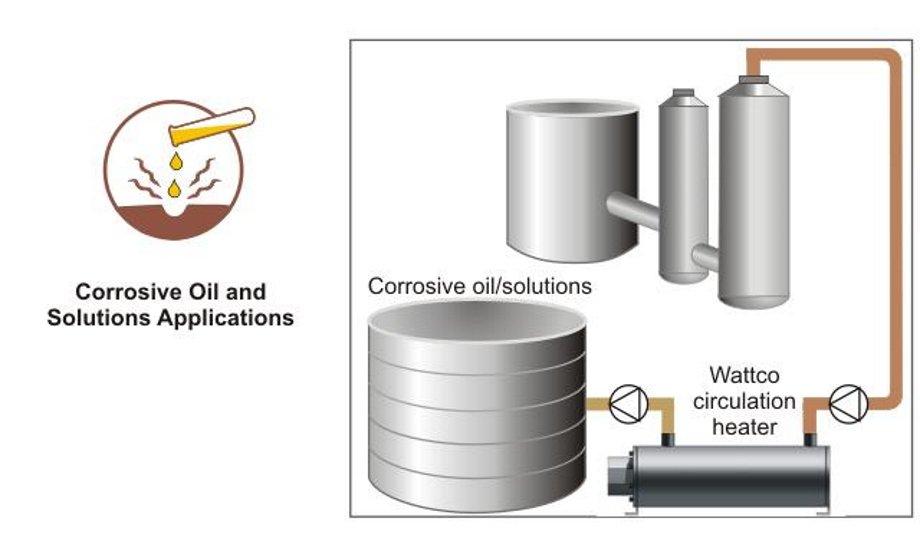

Heating corrosive solutions, whether alkaline or acidic, is often an important step in the process industry. Circulation heaters, from WATTCO, are designed and built to work for a variety of corrosive solutions.
Chemical composition of corrosive solutions plays an important role when selecting the correct circulation heater.
Construction
Circulation heaters are sturdily constructed of metals such as steel, or stainless steel. The heater is insulated so no heat can escape. Circulation heaters usually consist of flanged immersion heaters.
For corrosive solutions, the user must consider sheath and flange material as well as the container material of the circular heaters very diligently for effective heating. In particular, the user must select the tubular element sheath material with the appropriate w/in2.
operation
Desired temperature is achieved when the oil circulates through the length of the vessel
For proper heating, the corrosive should enter the circulation heater through the inlet nozzle which is near the flange immersion heater. Desired temperature is achieved when the oil circulates through the length of the vessel. The oil then leaves the heater through an exit nozzle.
For corrosive solution, the user can choose a wide range of container/vessel sizes, terminal boxes, and power (in kilowatts) ratings. There are two types of mounting for circulation heaters: horizontal and vertical. The vertical mounting is ideal if the space is limited.
Features of circulation heaters
One salient feature of circulation heaters is a valve for draining water. This valve can be installed anywhere in the vessel. It allows purging of oil, facilitating easy maintenance, when needed.
In circulation heaters, there are thermocouple probes or thermostats to control the oil temperature to the desired level and also for over-temperature protection. Thermo couples are mounted on the outlet nozzle for process control.
There are different types of terminal boxes for circulation heaters. In most cases, a basic terminal box is sufficient. The terminal boxes are also moisture resistant. With specialized terminal boxes, WATTCO circulation heaters are also approved for use in explosive environments.
Selecting the proper circulation heater
For corrosive solutions heating, the selection of circulation heater will depend on:
- The pH value
- Viscosity, specific heat and density of the heated medium
- Flow rate of the solutions
- Presence of contaminants, if any
- Sheath and container/vessel material
- Corrosion resistive property of the materials
One can also choose the mounting (horizontal or vertical) type, depending on the physical space that is available.
Benefits
Circulation heaters allow easy maintenance for servicing or replacing heating elements
Circulation heaters are capable of transferring heat very efficiently to the fluid medium. Since the heating is done at a different chamber/vessel, it is an ideal choice for a wide range of corrosive solutions.
Circulation heaters allow easy maintenance for servicing or replacing heating elements (rods). There is no need to drain the fluid from the fluid container.
Frequently Asked Questions
Q1: Why does a baffle is used in circulation heaters?
Circulation heaters also consist of baffles. These are small devices to control the flow of liquid inside the circulation heater. It controls the way the fluid is circulated inside the vessel.
Q2: Which parameters are very important for choosing the wattage requirement for circulation heaters (for heating corrosive solutions)?
The composition of corrosive solutions and the flow rate of the solution in gallons per minute (GPM) are two important parameters that the user must consider before selecting the correct circulation heater.