In the dynamic landscape of HVAC systems, air handling units serve as critical components for maintaining consistent airflow and energy efficiency in commercial buildings.
Historically, large centrifugal fans were the go-to solution, but they posed a significant challenge of having a single point of failure, leading to costly system downtimes and intricate repairs.
Moreover, replacing these massive units typically required structural alterations, complicating projects with extended timelines and heightened expenses.
To address these concerns, fan arrays were introduced in the early 2000s, employing multiple smaller fans to offer redundancy. If one motor failed, the others maintained functionality, reducing downtime.
However, this innovation brought new challenges, requiring separate wiring and controls for each fan, demanding intense coordination from electricians and increased long-term maintenance.
This scenario placed facility owners at a crossroads between simplicity and reliability. While single-motor fans presented risks, fan arrays introduced complexities that frustrated installation and maintenance efforts, particularly in retrofit projects.
This complexity slowed down processes and escalated costs, especially in time-sensitive replacements.
The search for a solution that balanced simplicity with redundancy led to the development of the multimotor plenum fan (MPF).
Designed to merge the best of both worlds, MPFs aim to be modular, easy to install, and deliver the reliable performance required by modern facilities.
An MPF integrates multiple motors into a unified plenum-style fan, offering built-in resilience without the cumbersome controls associated with fan arrays.
The key to MPFs' efficiency lies in their use of advanced electronically commutated (EC) motors. These high-efficiency motors remove the need for variable frequency drives (VFDs), offering precise speed control with less complexity.
EC technology streamlines components, reducing failure points and simplifying installation and maintenance compared to their AC counterparts.
MPFs are not only effective for new installations but are also exceptionally beneficial for retrofits.
Their adaptable design minimizes structural modifications, making them suitable for urgent replacements and planned upgrades.
Retrofitting existing systems with MPFs can lower energy consumption, reduce noise, and extend equipment lifespan, providing increased comfort for building occupants and substantial cost savings over time.
Q-PAC has been pivotal in advancing MPF technology. With experience in custom fan arrays, Q-PAC has spearheaded the design and implementation of MPFs across numerous North American installations. Their pre-engineered systems reduce the need for custom fabrication, streamlining installation and minimizing downtime.
The Q-PAC MPF system simplifies logistics by offering modular components that fit through standard elevators, as evidenced by its application in Pittsburgh's U.S. Steel Tower.
This approach allowed for a swift, less disruptive replacement process, completing a significant HVAC upgrade within a single weekend and achieving a 66% reduction in energy usage.
Today's HVAC systems require a balance of resilience and simplicity. The multimotor plenum fan stands out as a robust solution, offering simplicity akin to single-fan systems but with added redundancy.
This innovative approach reduces maintenance, cuts costs, and aligns with the operational goals of modern facilities, establishing MPFs as a forward-thinking choice for air handling efficiency.
Commercial buildings depend on air handling units to deliver consistent airflow, regulate indoor conditions, and keep energy consumption manageable. For decades, a single, large centrifugal fan, or blower, was the standard choice.
While effective in their time, these systems carry a significant drawback: a single point of failure. If that singular fan fails, the entire system can go offline, creating costly disruptions and forcing invasive repairs.
Replacements often require structural modifications to the building just to move these massive fans in or out of the air handler, making projects long, expensive, and highly disruptive.
Fan arrays
Fan arrays were introduced in the early 2000s to mitigate these risks. By using multiple smaller fans instead of a single large one, they offered built-in redundancy. If one motor failed, others could carry the load, preventing catastrophic downtime.
However, these systems introduced a new set of challenges. Each fan often requires separate wiring and controls, sometimes even its own VFD. That means more parts, more coordination among electricians and sheet metal fabricators, and more long-term maintenance.
In addition, many arrays are tied to specific fan models. If those become obsolete, facility managers face sourcing delays and higher costs. Over time, fan arrays gained a reputation for being overly complicated, labor-intensive, and expensive to maintain.
Choosing Complexity vs. Reliability
This created a difficult tradeoff for facility owners. The traditional single-motor fans are simple but risky. Fan arrays provide redundancy but layer on complexity that brings its own set of frustrations. For retrofit projects especially, this tension becomes clear.
Custom bulkheads, specialty electrical work, and multi-trade coordination all slow down installations and inflate costs. In urgent replacement situations where time is critical, the delays associated with fan arrays can drag out schedules and create avoidable risk.
Reliability without complexity
For building managers, the bottom line is that there is a constant trade off: they want reliability without complexity. They need a system that can continue running under any condition, but one that doesn’t require excessive coordination or ongoing maintenance and upkeep.
The limitations of both single-fan and multi-fan systems opened the door to a new idea. Engineers began exploring ways to combine the redundancy of arrays with the simplicity of a single fan.
The goal was to create a solution that could be modular, adaptable, and simple to install, while still delivering the reliability modern facilities require. That search gave rise to a new category: the multimotor plenum fan (MPF).
The Multimotor Plenum Fan
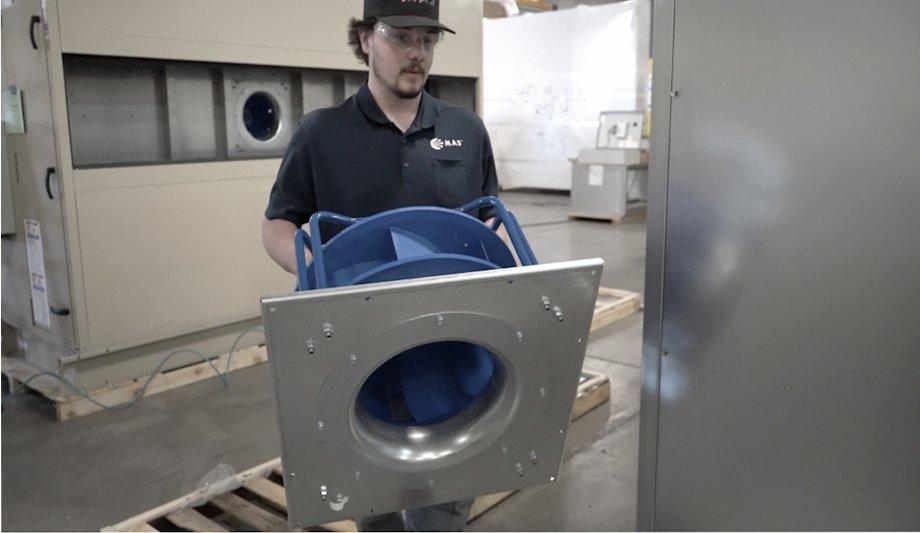
An MPF integrates multiple motors and impellers into a single plenum-style fan. Like arrays, it offers built-in resiliency, allowing airflow to continue even if one motor goes down.
But unlike arrays, it eliminates the need for dozens of independent control points, variable frequency drives (VFDs), and bulkhead modifications. The entire system operates as one cohesive device, with modular, lightweight components designed for no-hassle installation.
Understanding MPF Design and Performance
Beyond their resiliency, multimotor plenum fans deliver important performance and efficiency benefits. One of the most significant advantages is the use of advanced electronically commutated (EC) motors.
These compact, high-efficiency motors eliminate the need for VFDs, offering precise speed control with less complexity. By reducing the number of components, EC technology minimizes failure points, improves reliability, and simplifies both installation and maintenance.
EC motors regulate speed by varying the DC voltage delivered to the fan. Their use of permanent magnets and integrated electronic controls eliminate slip and optimize torque generation, resulting in higher efficiencies than AC motors across their varied operating speeds.
EC motors
On average, EC motors are about 40% more efficient than standard AC motors and roughly 15% more efficient than AC motors paired with VFDs. The result is significant energy savings, lower operating costs, and measurable sustainability gains.
To further streamline performance, many manufacturers directly mount EC motors to an impeller. The most common forms feature backward-curved blades balanced to AMCA standards, reducing rolling mass and slippage. This design cuts energy loss, extends bearing life, and improves long term reliability.
Benefits for Retrofit Applications
Multimotor plenum fans are not only ideal for new HVAC installations but are highly valued for retrofit applications. Their adaptability means they can address both urgent replacements and planned upgrades without requiring extensive structural modifications.
The philosophy behind the MPF is to deliver a complete, all-in-one solution. Modular components allow the fan to be customized to a wide range of dimensional and performance needs.
When used for planned upgrades, MPFs offer substantial improvements in energy efficiency, noise reduction, and equipment lifespan. Retrofitting existing units with these fans can immediately lower energy consumption while also delivering quieter operation and reduced maintenance operation.
The result is not only improved comfort for building occupants but also meaningful cost savings over the life of the system when you consider both the energy usage and the time and labor savings. Their adaptable nature ensures broad compatibility, making them a future-proof choice for managers who want to reduce environmental impacts while maintaining reliable performance.
Q-PAC’s Role in Advancing MPF Technology
Q-PAC, a major manufacturer of advanced fan systems, has played a central role in bringing this technology to market. With years of experience in custom fan arrays, the company helped pioneer the design and manufacturing of the multimotor plenum fan and has supported its adoption across thousands of installations in North America.
Their use of adaptable fan frames, simplified fan connections, and straightforward configuration tools have demonstrated how customer-focused design can make specifying and installing these systems simpler and more reliable.
Instead of requiring contractors to fabricate custom sheet metal bulkheads or run separate wiring to each motor, the Q-PAC MPF arrives pre-engineered. The adaptive fan frame can be scaled to fit any air handler size, with interlocking structural panels and prefabricated plug-terminated harnesses that eliminate many of the challenges that slow down conventional retrofits.
Streamlined ordering process
The system requires fewer trades on-site, minimizes downtime, and reduces long term maintenance complexity.
The Q-PAC ordering process is also streamlined with digital configuration tools, enabling facility teams to input system requirements, such as air handler dimensions and target airflow, and receive optimized configurations instantly.
In critical cases, Q-PAC MPFs can even be built and shipped in as little as 48 hours, minimizing disruption for tenants and restoring airflow quickly. By coupling engineering expertise with practical delivery, Q-PAC has shown how the MPF can bridge the gap between resiliency and simplicity in real world applications.
Simplifying logistics
A striking example of this approach was seen in Pittsburgh’s tallest building, the U.S. Steel Tower. A massive 1970s-era centrifugal fan serving 14 floors failed unexpectedly. Replacing it with a similar unit would have required cutting a hole in the building and using a crane to lift new equipment, which would have been an invasive, disruptive, and expensive process.
With a Q-PAC Fan, technicians were able to hand carry modular components through elevators and assemble them on-site. Demolition, removal, and installation were completed in less than 48 hours over a single weekend, reducing tenant disruption and cutting energy usage by an impressive 66%.
This project underscores how the Q-PAC Fan design not only simplifies logistics but also accelerates timelines and reduces operating costs, bridging the gap between resiliency and simplicity in a way that earlier systems could not.
Building Toward Smarter Air Handling
The evolution of fan systems shows a clear trajectory: facilities need smarter solutions that balance resiliency and simplicity. The MPF provides that balance, transforming retrofit projects from complicated, multi-trade endeavors into straightforward upgrades.
Contractors appreciate the streamlined installation process, while building owners benefit from lower costs, faster deployment, and a more sustainable system.
Smarter Air Handling for the Future
Traditional single-fan systems are too risky, and fan arrays are too complicated. The multimotor plenum fan offers a smarter path forward, combining resiliency, efficiency, and simplicity in one design. For facility managers weighing retrofit options, this approach minimizes disruption, eliminates the need for ongoing maintenance, and supports long term operational goals.
By focusing on customer needs, like speed, adaptability, and sustainability, MPFs are setting a new standard for air handling in modern commercial buildings.