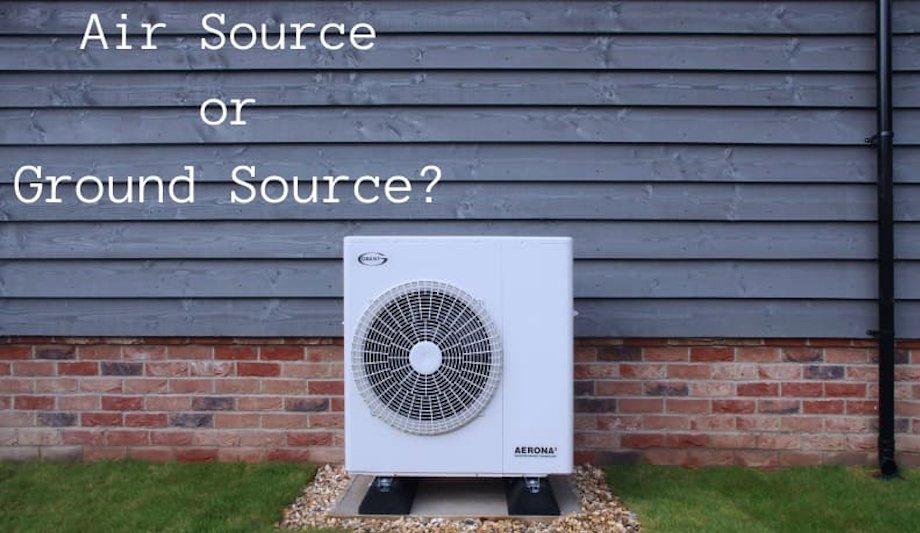

Heat pumps offer a promising low-carbon alternative to fossil fuel heating for many homes in the UK.
They provide highly efficient domestic heating and significant energy savings when replacing oil or gas central heating, reducing carbon emissions and in some cases saving money on fuel bills.
The two types of heat pumps – Air Source (ASHP) and Ground Source (GSHP) – work in a very similar way, but in practice there are many differences for both installers and consumers to consider.
Heat pumps operation
Heat pumps absorb heat from a natural source before transferring it to a refrigerant
Heat pumps absorb heat from a natural source before transferring it to a refrigerant, which turns from a liquid to a gas. This gas is then compressed to increase the temperature.
Finally, a second heat exchanger transfers the heat from the refrigerant to water for domestic use and space heating, passing through radiators or underfloor heating.
GSHP or ASHP
ASHPs extract heat from outside air and can work in temperatures as low as -20 degrees Celsius GSHPs draw heat from the ground via a loop of pipe buried in the garden. The length of the pipe depends on how much space is available and how much heat the home needs – a longer pipe will draw more heat.
Generally, a GSHP installation requires extensive outside space, however, in some cases a borehole can be drilled to bury the pipework.
By contrast, ASHPs extract heat from outside air and can work in temperatures as low as -20 degrees Celsius. They do not require buried pipework and therefore offer a much less disruptive solution for most properties. An ASHP is made up of two units, one external and one internal, which usually take up no more room than a modern gas boiler.
ASHP and GSHP installation costs
An ASHP costs around £9,000 – £11,000 to install. For a GSHP it is much more, upwards of £14,000, considering the extra labour required to survey the land and bury the pipes.
Both GSHPs and ASHPs are eligible for Renewable Heat Incentive (RHI) payments which should pay back the installation costs over a period of 7 years.
Efficiency of ASHP and GSHP
Heat pumps achieve much greater efficiencies than gas, oil and conventional electric heating
Heat pumps achieve much greater efficiencies than gas, oil and conventional electric heating. This is because rather than generating heat by converting electricity or burning fuel, they make use of existing heat and simply move it around.
Generally, heat pumps are more than 100% efficient, meaning they deliver more heat than the electrical energy they use.
GSHPs can be up to 400% efficient, whereas an ASHP is slightly less. GSHPs are unaffected by seasonal changes and benefit from the constant ground temperature of around 10 – 13 degrees Celsius, retaining a constant efficiency all year round.
Advantages of ASHP
An ASHP has to work much harder during the winter months when air temperatures drop
An ASHP has to work much harder during the winter months when air temperatures drop, just when heat is most in demand.
Despite this, ASHPs still offer high efficiencies throughout the year.
GSHPs also have the slight edge over ASHPs because they use water rather than air to extract heat. Water is a better thermal conductor than air, meaning heat moves more easily through it, leading to greater efficiencies.
Training as a heat pump installer
Training as a heat pump installer is a great move for experienced heating installers looking to expand their skill set and future-proof their careers.
Demand for heat pumps is strong, and the technology is expected to make a big contribution to the decarbonization of domestic heat as UK move towards its 2050 carbon targets.
While GSHPs are more efficient in the long-term, the barriers to installation mean that ASHPs will be the most practical choice for the vast majority of homes.