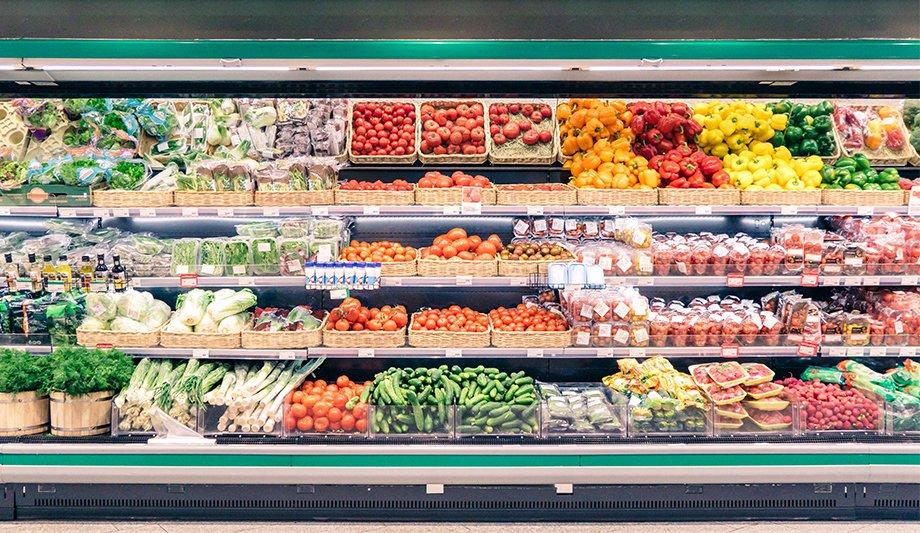


Across the globe, annual food loss amounts total to approximately 1.3 billion tons of waste and 4.4 gigatons of greenhouse gas (GHG) emissions.
To put that in perspective: If food waste were a country, it would rank as the third largest GHG emitting country in the world, surpassed only by the United States and China.
The average supermarket, which brings in about $35M in annual revenue, will see $526,590 worth of food waste and 3,600 MWh worth of wasted energy use, where about 2,000 MWh is used for refrigeration—the equivalent of 170 households.
SaaS for temperature monitoring
Clearly, there is both an economic and sustainability burden to food loss besides the revenue loss and environmental impact. Luckily, this burden can be eased when using Software as a Service (SaaS), like food temperature monitoring. Supermarkets who monitor their food temperatures will improve their margins and overall profitability by selling food at its full price rather than marked down due to over ripening or close to expiration date. This, in turn, will deliver improved customer satisfaction because supermarkets will be able to continue to stock fresh food while minimizing the sale of old and ripened provisions.Supermarkets who monitor their food temperatures will improve their margins and overall profitability
There are many benefits of using SaaS to improve supermarket efficiency, which can help to reduce food waste and lower energy costs in countless supermarkets worldwide. Many of the roughly 50,000 food retail locations that utilize electronics controllers use some level of SaaS technology like Alsense Food Retail Services, the newest cloud offering from Danfoss Climate Solutions for supermarkets and food retail applications.
Alsense Food Retail Services is a sustainable, scalable, and secure modern platform that delivers tangible data to improve operational and energy efficiency while optimizing the performance of food retail operations. Its technology is engineered to provide supermarkets with actionable insights that allow you to track refrigeration asset performance, respond to alarms, integrate 24/7 monitoring, reduce energy consumption, and more to deliver savings as high as a 40% reduction in food waste and 30% decrease in energy costs.
Examples of food loss prevention with Alsense Food Retail Services
- The sensor in the meat fridge notices a high temperature and submits an alarm to the cloud
- The alarm is analyzed by the Danfoss Enterprise Service Team (Managed services)
- The reason for the alarm is determined and a service provider is contacted
- The service provider is dispatched to the supermarket to fix the issue in the meat fridge to avoid food loss
- Danfoss’ advanced algorithms detect if the refrigeration systems are running efficiently or if they are over consuming energy
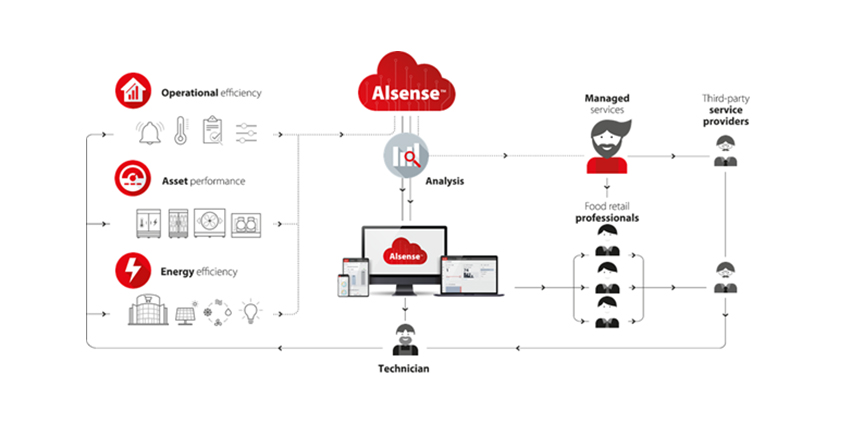 |
| Alsense Food Retail Services is a sustainable, scalable, and secure modern platform that delivers tangible data to improve operational and energy efficiency while optimizing the performance of food retail operations |
aktiv & irma, a supermarket in North Germany, has shown significant savingsWithout SaaS, the store’s ROI will take much longer than if you rely solely on the hardware as part of the Alsense Food Retail Services pilot program. In collaboration with Danfoss, they installed a solar photovoltaic system, storage system, and a charging station for guests. All major assets in the supermarket system are linked through the Alsense Food Retail Services cloud to manage loads and eliminate unnecessary peaks to best use each store’s energy. Regulating energy levels is accomplished through a variety of methods that offer potential savings:
- Load shifting: As high as 20 kW in additional peak reductions ($1,758.30 potential savings). Compressor curtailment
- Solar: 112 MWh electricity produced ($16,410.80 savings)
- Battery: Grid demand reduced by 40 kW ($3,516.60 savings)
- Peak load shaving: Charging station is throttled if needed to maintain target max peak level in the store. ($2,344.40 potential savings)
aktiv & irma saved about 15% in additional energy costs and reduced over 70 tons of CO2 for a total savings of $20,168.80 compared to other supermarkets.
For supermarkets that are considering marrying SaaS with their hardware expenditure, the return on investment (ROI) will depend largely on their level of SaaS investment. Without SaaS, the store’s ROI will take much longer than if you rely solely on the hardware. To put it simply, the more robust the SaaS program, the quicker supermarkets will see a return on the overall system investment.
Alsense Food Retail Services?
A zero-net, even net positive, billable energy supermarket is possible. The prerequisites to make these savings happen are based on energy efficiency, particularly reducing overall consumption and onsite heat and electricity generation and storage. Energy arbitrage services can enable energy bill optimization. Essentially, this means that energy can be stored in a battery and used when prices in the grid are high.Precooling can also be used to cool down cabinets before prices increase Precooling (curtailment) can also be used to cool down cabinets before prices increase.
Another option is to turn off compressors for as long as possible when the energy prices are high. This means temperatures will drift upwards, so turn on the compressors before the temperature compromises food quality. Lastly, supermarkets have further potential to balance the grid via fast Frequency Response, peak Load Shifting, and seasonal Buffering.
SaaS technology, like Alsense Food Retail Services, is a strong compliment to hardware assets that can help supermarkets achieve higher profitability and food loss and waste reduction. If a supermarket aims to go zero- or positive-net, the solution is to invest in both hardware and SaaS.