

The amount of carbon dioxide (CO2) in a poorly ventilated indoor space depends on the number of people who exhale their breath in that space. And aerosol virus contained in exhaled breath is a common way that COVID-19 germs are spread. Therefore, might the CO2 level in a given space serve as an approximation of the likelihood of coronavirus spread?
Broadly speaking, poor ventilation of indoor spaces can increase the likelihood of aerosol transmission, and a higher CO2 level is an indicator of insufficient ventilation. In indoor spaces, the CO2 concentration should not exceed 1,000 parts per million (ppm), which is higher than the 400 ppm concentration in the fresh air.
Deployment Of CO2 Sensors
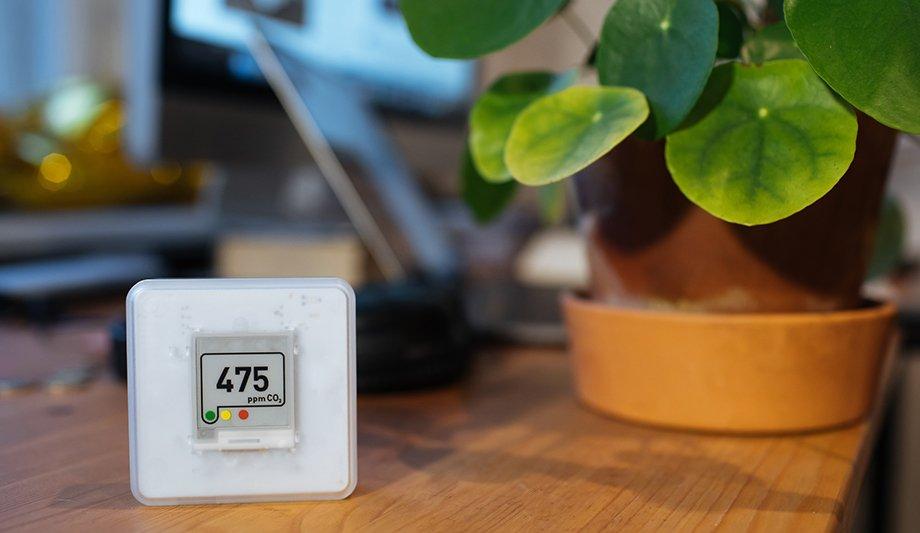
Measuring aerosols in the air is complex and expensive. However, measuring CO2 is inexpensive. Using low-cost and compact CO2 sensor devices can help to warn against high concentrations of CO2 in the air, and by extension, the likely higher levels of aerosols and greater virus spread.
Seeking to provide a warning of high CO2 levels (and thus a likely higher concentration of aerosols) points to a need to increase deployment of inexpensive CO2 sensors in a variety of applications. The simplest implementation might be a CO2 traffic light that signals air quality changes with red, yellow, and green lights.
Data Analysis, Remote Access, & Monitoring
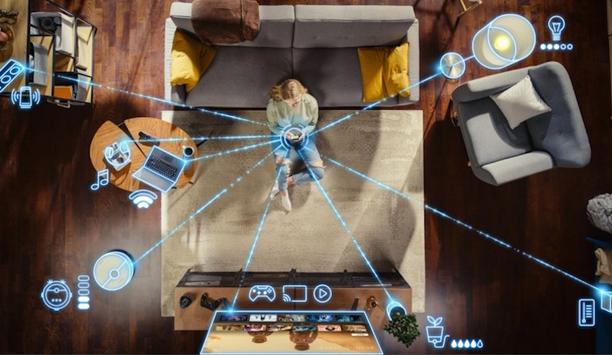
CO2 sensors tied to the cloud for data analysis, remote access, and monitoring and linked to other IoT devices CO2 sensors can also be tied to the cloud (along with other sensors) for data analysis, remote access, and monitoring. They might be linked to other Internet of Things (IoT) devices such as air purifiers and thermostats.
CO2 sensors that are the most accurate tend to be bulky and expensive. However, using a microelectromechanical system (MEMS) technology, a CO2 sensor based on photoacoustic spectroscopy (PAS) can analyze CO2 concentration in parts per million. It provides precise results in a small format.
CO2 Levels Proxy For COVID-19 Transmission
Each person in a building will exhale approximately 8 liters of air per minute. The air has been in contact with lung tissue and contains tiny liquid droplets (aerosols) that can float in the air. Exhalation air also has a concentration of about 40,000 ppm of carbon dioxide, which increases the CO2 levels in a room. In effect, CO2 levels can be used as a proxy for COVID-19 transmission risk.
Evidence shows that long-range aerosol-based transmission routes play an important role in transmitting the SARS-CoV-2 coronavirus. Therefore, analyzing aerosol concentration provides an indicator of the safety of an indoor space. Because of the close link between indoor CO2 concentration and aerosol density, using CO2 sensors to monitor an indoor environment can help to monitor possible indoor spread.
CO2 Monitoring
The Federation of European Heating, Ventilation, and Air Conditioning Associations (REHVA) in Germany has published guidelines for schools to use CO2 monitoring, including the use of a traffic light indicator. In addition to CO2 levels, other factors should also be considered when determining infection risks, such as the number of infected people in a region, activity type, air filtration, and mask-wearing.
Activities such as talking, singing, or shouting can increase risk. Ventilation using outdoor air dilutes both CO2 and virus concentrations. Germany’s Federal Environment Agency’s general guidelines for health assessment of carbon dioxide in indoor air include advice relevant to COVID-19. The guideline classifies any CO2 concentration between 1,000 and 2,000 ppm as questionable; anything above 2,000 is unacceptable.